-
-

Choosing the right HDPE pipe for underground water systems requires more than selecting a diameter from a product catalog. Pressure rating, SDR, flow demand, burial conditions, soil support, installation method and joining quality can all influence the long-term performance of a buried pipeline.
For municipal water distribution, industrial water transfer and large infrastructure projects, an underground water pipe must withstand both internal water pressure and external loads from soil, traffic and ground movement. HDPE is widely considered for these applications because of its corrosion resistance, flexibility and fusion joining capability.
The correct HDPE water pipe, however, should always be selected according to actual project conditions rather than choosing the largest diameter or highest pressure class available.
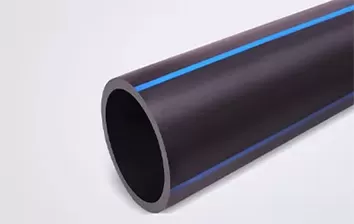
HDPE pipe for underground water is a pressure piping solution used to transport potable or non-potable water through buried distribution and transmission networks.
High-density polyethylene combines flexibility with resistance to corrosion and many chemicals commonly encountered in buried environments. Unlike metallic pipes, polyethylene does not require protection against electrochemical corrosion, which can be valuable where soil conditions are aggressive.
HDPE is commonly considered for municipal water mains, industrial water transmission, irrigation networks, utility crossings and trenchless pipeline projects. Its flexibility also allows the pipe to accommodate moderate changes in alignment and certain ground movements without relying on numerous fittings.
Fusion joining is another important characteristic. Proper butt-fusion or electrofusion joints can create a continuous pipeline system, helping reduce reliance on separate mechanical joints along long underground runs.
JIANGTE's PE pipe for water supply is manufactured in PE80 and PE100 grades and is available in multiple SDR and pressure classes. JIANGTE states that its current water-supply range can reach DN1600, providing options for both distribution and large-diameter water infrastructure applications.
For potable-water applications, project designers should also verify that materials meet applicable health requirements. The NSF/ANSI/CAN 61 drinking-water standard addresses health-effects requirements for components that come into contact with drinking water.
HDPE pipe pressure rating and size selection should be based on design pressure, required flow, pipe material grade and the relationship between outside diameter and wall thickness.
One of the most important concepts is SDR, or Standard Dimension Ratio. A lower SDR generally means a thicker pipe wall relative to the outside diameter and therefore a higher pressure capability for the same material grade.
JIANGTE's PE100 water-supply range includes SDR values such as SDR41, SDR33, SDR26, SDR21, SDR17, SDR13.6, SDR11 and SDR9, with listed nominal pressure options extending up to 2.0 MPa for applicable PE100 configurations.
| Selection Factor | What to Check | Why It Matters |
|---|---|---|
| Pressure rating | Operating and surge pressure | Determines required SDR/pressure class |
| HDPE pipe size | Flow demand and velocity | Affects hydraulic capacity |
| Material grade | PE80 or PE100 | Influences design strength |
| Burial condition | Soil, depth and surface load | Influences structural support |
| Pipe route | Length, bends and elevation | Affects pressure loss and installation |
Selecting HDPE pipe size should therefore start with hydraulic requirements rather than simply matching an existing nominal diameter. An undersized pipe can create excessive velocity and pressure loss, while unnecessary oversizing may increase material and installation costs.
For North American municipal applications, AWWA water-pipe standards include AWWA C906 for polyethylene pressure pipe and fittings. Final size and pressure class should always follow the project's applicable engineering standard and design calculations.
HDPE pipe installation requires appropriate trench preparation, pipe handling, joining, embedment and backfilling so that the buried pipe works together with the surrounding soil.
Even high-quality pipe can perform poorly if installation conditions are not properly controlled. The Plastic Pipe Institute notes that underground PE installation design should consider site conditions, subsurface soil, burial depth, live loads and the level of support provided by the surrounding material.
Important HDPE pipe installation considerations include:
Trench and bedding conditions: The pipe should receive appropriate support without sharp objects or unsuitable materials creating concentrated loads.
Fusion quality: Butt fusion or electrofusion procedures should use suitable equipment and trained operators so joints meet project requirements.
Backfill and compaction: Embedment material should be placed and compacted according to the engineered installation specification.
External loading: Traffic, deep burial and weak soil conditions may require project-specific structural analysis.
There is no universal minimum burial depth suitable for every HDPE water line. Required cover depends on pipe diameter, SDR, soil properties, groundwater, traffic loading, frost conditions and local regulations.
The PPI underground installation guidance for PE piping provides detailed engineering guidance covering excavation, bedding, embedment, backfill and soil-pipe interaction.
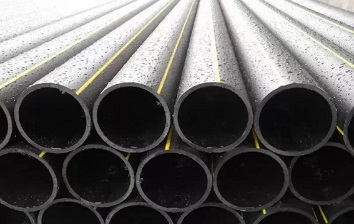
For municipal projects involving several types of buried infrastructure, JIANGTE's municipal piping systems include PE water supply, drainage, gas and other utility piping solutions.
HDPE underground water pipes offer a combination of corrosion resistance, flexibility, fusion joining and long-term durability that makes them suitable for demanding buried-water applications.
One significant advantage is adaptability to uneven ground conditions. JIANGTE lists an elongation at break of more than 500% for its PE water-supply products and a material density of approximately 0.94–0.965 g/cm³, contributing to both toughness and relatively easy handling.
The material's flexibility can also reduce the number of directional fittings required on gradual route changes. For trenchless methods such as horizontal directional drilling, this flexibility can be particularly valuable.
Fusion joining can further improve network integrity. Instead of depending on a mechanical connection at every pipe length, properly fused HDPE sections form a continuous pipeline, which is useful for long transmission mains and difficult-to-access underground routes.
However, these benefits do not mean every HDPE grade or dimension is suitable for every project. Pressure, temperature, soil support and installation loads still need to be considered together.
JIANGTE provides a broader range of PE pipe products for municipal, building, agricultural and industrial pipeline applications, allowing project teams to match pipe construction to the required service environment.
Choosing the right HDPE pipe for underground water requires a systematic review of pressure rating, SDR, HDPE pipe size, hydraulic demand, soil conditions, burial depth and installation method.
HDPE offers important advantages for buried water systems, including corrosion resistance, flexibility and fusion joining, but successful performance still depends on correct engineering and installation. For municipal or large-scale underground water projects, JIANGTE can provide PE80 and PE100 water-supply pipe options in multiple diameters, SDR classes and pressure ratings to match specific project requirements.
The appropriate pipe depends on operating pressure, flow demand, diameter, burial conditions and applicable standards. PE100 is widely used for pressure-water systems, but SDR and pressure class must still be selected for the specific design.
HDPE pipe size should be determined using required flow rate, acceptable velocity, pressure loss, route length and available operating pressure rather than selecting diameter by application alone.
There is no single burial depth for every project. Soil conditions, frost depth, traffic loads, pipe diameter, SDR and local codes all affect the required cover.
Yes, HDPE can be used for potable-water systems when the pipe, fittings and materials comply with the applicable drinking-water and project standards.
SDR is the ratio between pipe outside diameter and wall thickness. For the same HDPE material, a lower SDR generally corresponds to a thicker wall and higher pressure capability.
Service life depends on material quality, operating conditions, pressure, temperature and installation quality. JIANGTE states that its PE pipe products are designed for a service life of up to 50 years under suitable application conditions.