-
-

Choosing the correct HDPE pipe sizes is essential for water supply, municipal infrastructure, industrial pipelines and buried utility projects. A pipe that is too small can increase flow velocity and pressure loss, while unnecessary oversizing may increase material, excavation, fittings and installation costs.
Unlike some traditional piping systems, HDPE pipe dimensions are closely related to outside diameter, wall thickness and Standard Dimension Ratio, or SDR. Two pipes with the same outside diameter can therefore have different internal flow areas and pressure capabilities when their SDR ratings are different.
For engineers and buyers, understanding HDPE pipe diameter, SDR and wall thickness before requesting a quotation makes it easier to specify the correct pipe and avoid costly changes during installation.
HDPE pipe sizes are generally identified by nominal outside diameter together with wall thickness or SDR, rather than by outside diameter alone.
For pressure-pipe applications, outside diameter remains fixed for a particular nominal size while the wall thickness changes according to the selected SDR. A thicker wall reduces the internal diameter but generally allows the pipe to operate at a higher pressure for the same material grade.
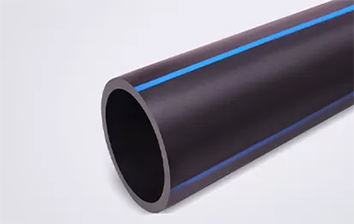
For example, JIANGTE's PE pipe for water supply is categorized according to nominal outside diameter, nominal wall thickness and pressure-related SDR. Its current product range includes SDR41, SDR33, SDR26, SDR21, SDR17, SDR13.6, SDR11 and SDR9, with a maximum listed pipe diameter of DN1600 and customized special sizes available.
This is why a specification such as “DN315 HDPE pipe” is often not sufficient for procurement. The engineer may also need to specify the material grade, SDR and applicable pressure requirement.
International specifications follow the same general approach. ISO 4427-2 covers polyethylene pipes for pressure water, drainage and sewerage applications and defines requirements for PE pipes used in buried and above-ground systems.
Understanding these relationships is the foundation for interpreting any HDPE pipe size chart correctly.
An HDPE pipe diameter chart shows how nominal outside diameter relates to wall thickness, SDR and the resulting internal flow area of the pipe.
The table below illustrates the engineering relationship rather than replacing a manufacturer's certified dimensional table.
| Parameter | What It Means | Engineering Impact |
|---|---|---|
| Nominal outside diameter | External diameter of the pipe | Determines fittings, joining equipment and overall pipe size |
| Wall thickness | Thickness of the PE pipe wall | Influences internal diameter and pressure capability |
| Internal diameter | Approximate clear flow opening | Affects flow capacity and velocity |
| SDR | Outside diameter ÷ wall thickness | Indicates the relative wall thickness |
| Material grade | Commonly PE80 or PE100 | Influences allowable pressure design |
As HDPE pipe diameter increases, hydraulic capacity generally increases, but diameter should not be selected by flow rate alone. Pressure losses, total pipeline length, elevation changes, pump characteristics and required residual pressure also influence sizing.
The outside diameter must also be coordinated with fittings and joining equipment. This is particularly important for fusion systems, where pipe and fitting dimensions must be compatible.
For waterworks applications in North America, AWWA C906 covers PE pressure pipe and fittings from 100 mm through 1,650 mm (4 through 65 inches) for waterworks applications.
For municipal buyers handling several pipeline categories, JIANGTE's municipal piping systems include PE water supply, drainage and other utility pipe products.
SDR describes the ratio between the outside diameter of an HDPE pipe and its minimum wall thickness, making it one of the most important factors in understanding HDPE pipe dimensions.
The basic relationship is straightforward: as the SDR number becomes lower, the pipe wall becomes thicker relative to the outside diameter.
For example, an SDR11 pipe has a thicker wall than an SDR17 pipe of the same outside diameter. As a result, the SDR11 configuration will generally provide higher pressure capability but a smaller internal flow area.
JIANGTE's PE100 water-supply specifications illustrate this relationship. The company's listed SDR options range from SDR41 through SDR9, with corresponding PE100 nominal pressure classes extending from approximately 0.4 MPa to 2.0 MPa, depending on the selected SDR.
This means that simply requesting an “SDR11 pipe” or “SDR17 pipe” without specifying diameter and material grade can still leave important engineering information undefined.
An engineer comparing SDR11 and SDR17 pipe should consider both pressure and hydraulics. The thicker SDR11 wall can support a higher pressure class, but because it occupies more of the pipe cross-section, the same outside diameter produces a smaller internal diameter than SDR17.
The Plastics Pipe Institute PE Handbook provides additional engineering guidance on PE pipe design, material properties, pressure systems, installation and joining.
Selecting the correct HDPE pipe size requires matching hydraulic demand, pressure conditions and installation requirements rather than simply choosing the nearest nominal diameter.
Project engineers and buyers should evaluate four main areas:
Required flow and velocity: Calculate the expected design flow and confirm that the selected internal diameter can deliver it without excessive velocity or friction loss.
Operating and surge pressure: Select the material grade and SDR according to normal operating pressure as well as temporary pressure fluctuations.
Pipeline route: Consider total length, elevation difference, bends, fittings and other sources of head loss.
Installation conditions: Burial depth, soil, trenchless installation, temperature and external loading may influence the final specification.
An important purchasing mistake is selecting HDPE pipe sizes purely from a previous project. Two pipelines carrying the same amount of water may require different diameters if their lengths, elevations or available pressures are different.
Another issue is evaluating only outside diameter. Because wall thickness changes with SDR, two pipes that appear to have the same nominal diameter may offer different internal hydraulic capacity.
JIANGTE offers PE80 and PE100 water-supply pipe in multiple diameters and SDR classes, including customized sizes for project-specific requirements. For projects where diameter, SDR or pressure class has not yet been finalized, buyers can contact JIANGTE with flow, pressure, application and dimensional requirements for product and quotation support.
Correct HDPE pipe sizes are determined by the relationship between outside diameter, wall thickness, SDR, pressure rating and hydraulic demand. An HDPE pipe size chart is useful for comparing available dimensions, but the final selection should also consider flow rate, pressure loss, elevation, installation method and applicable engineering standards.
For engineering projects, JIANGTE provides multiple HDPE pipe diameter and SDR combinations up to DN1600, helping municipal and industrial buyers match HDPE pipe dimensions to actual project requirements rather than relying on nominal diameter alone.
HDPE pipes are produced across a broad range of outside diameters depending on the applicable standard and manufacturer. JIANGTE's current PE water-supply range reaches DN1600, with special sizes also available.
Pressure HDPE pipe is commonly specified using nominal outside diameter. The corresponding internal diameter depends on the wall thickness and SDR of the selected pipe.
SDR means Standard Dimension Ratio. It expresses the relationship between the pipe's outside diameter and wall thickness.
For the same outside diameter and material grade, SDR11 has a thicker wall than SDR17. This generally provides higher pressure capability but reduces the available internal diameter.
A larger internal diameter generally provides greater hydraulic capacity, but actual flow also depends on pipe length, pressure, elevation, fittings and system design.
Determine the required flow, available pressure, expected pressure loss, route length, elevation, applicable SDR and installation conditions. The final HDPE pipe size should then be confirmed through hydraulic and engineering calculations.